Breathing Smoke: The Hidden 'Cigarette Equivalent' of Winter Smog in 4 Global Megacities
Breathing Smoke: The Hidden 'Cigarette Equivalent' of Winter Smog in 4 Global Megacities
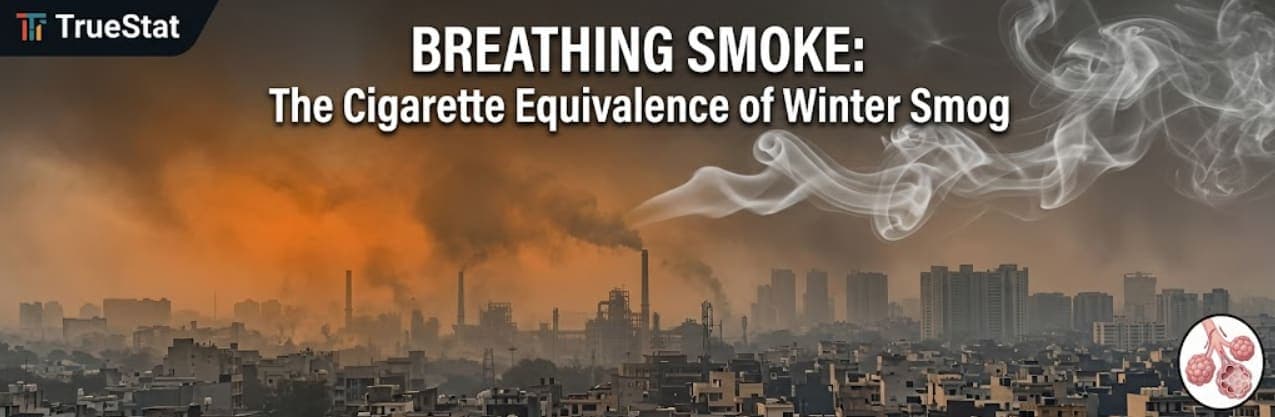
If you live in a major metropolitan area, you probably have a morning routine that looks something like this: you wake up, check your phone for the weather, and then, right below the temperature, you check the air quality. We have become a society that treats the Air Quality Index (AQI) with the same casual normalization as the chance of rain.
We see an AQI of 150 and think, "Oh, it's a bit hazy today." We see an AQI of 400 and think, "Guess I'll skip the morning jog."
But here is the problem with the AQI: it is entirely abstract. It is a mathematical index designed by environmental agencies to standardize reporting, but it completely fails to visceralize the actual, biological toll that microscopic pollution takes on our bodies. A color-coded dial turning from orange to purple doesn't trigger the human survival instinct the way it should.
To bridge this gap and make the data actually mean something to the average citizen, data scientists and respiratory health researchers look to a much more relatable, undeniably human metric: The Cigarette Equivalence.
Based on groundbreaking methodology and mathematical modeling from Berkeley Earth, breathing in 22 micrograms per cubic meter (μg/m³) of PM2.5 (fine particulate matter) for a 24-hour period is the health equivalent of smoking exactly one cigarette.
Using TrueStat's TrueBreath analytics engine, we decided to strip away the confusing color wheels of standard weather apps. We analyzed the peak winter pollution data (November through January averages) across four major global financial and cultural hubs to see exactly what citizens are inadvertently smoking just by existing in their own cities.
The Anatomy of a Micro-Killer: Why PM2.5 Matters
Before we dive into the city-by-city breakdown, we need to understand the villain of this story. Why do we measure PM2.5 specifically, ignoring larger dust particles or standard emissions?
Think about a single strand of your hair. Now, imagine something roughly 30 times smaller than the width of that single strand. That is PM2.5. These are microscopic droplets and solid particles created by combustion—exhaust from cars, coal power plants, burning wood, and industrial emissions.
Unlike larger dust particles (known as PM10), which are conveniently trapped by the mucus in your nose and throat, PM2.5 is insidious. Because of its microscopic size, it completely bypasses your body's natural respiratory defenses.
When you inhale PM2.5, the particles travel deep down your windpipe and settle into your alveoli—the tiny, delicate air sacs in your lungs responsible for exchanging oxygen with your blood. From there, the particles are so incredibly small that they cross the cellular barrier directly into your bloodstream. Once in your blood, they trigger systemic inflammation, increase the risk of plaque buildup in your arteries leading to heart attacks, and drastically elevate the long-term risk of lung cancer.
Crucially, this is the exact same biological pathway—and causes the exact same cellular damage—as inhaling tobacco smoke. Your lungs cannot tell the difference between particulate matter from a diesel truck and particulate matter from a Marlboro.
The Global Winter Data Breakdown
Winter is notoriously the most dangerous season for air quality globally. This is due to a meteorological phenomenon called "temperature inversion." Normally, warm air rises, carrying pollution up and away into the atmosphere. But in winter, cold air settles heavily near the ground, creating a literal lid that traps vehicle exhaust, industrial smoke, and agricultural fires right at street level.
Here is how the world's major cities stack up during their suffocating winter months:
1. New Delhi, India: The Unwilling Smokers
Average Winter PM2.5: ~330 μg/m³
The Reality: Delhi faces a unique, almost insurmountable "perfect storm" every winter. You have the baseline emissions of a sprawling metropolis packed with millions of vehicles. Then, you add the geographical trap of the Himalayas to the north blocking wind clearance. Finally, you introduce the seasonal burning of leftover crop stubble in the neighboring agricultural states of Punjab and Haryana.
The Equivalence: At a winter average of 330 μg/m³, a completely non-smoking resident of New Delhi—including children and the elderly—is passively smoking 15 cigarettes a day. On peak smog days in November, where PM2.5 frequently breaches 500 μg/m³, that number climbs to over a full pack (22+ cigarettes) daily.
2. Beijing, China: The Improving Giant
Average Winter PM2.5: ~110 μg/m³
The Reality: If we wrote this article a decade ago, Beijing's air quality would have rivaled or even exceeded Delhi's. The infamous "Airpocalypse" of 2013 forced the Chinese government to declare a literal war on pollution. Through aggressive, sweeping state policies—including forcibly shutting down coal plants around the capital and heavily restricting vehicle registrations—they have successfully halved their pollution levels.
The Equivalence: While Beijing is heralded as a success story in environmental policy, the baseline is still dangerous. During the cold months, Beijing residents are still effectively smoking 5 cigarettes a day.
3. London, United Kingdom: Escaping the Great Smog
Average Winter PM2.5: ~22 μg/m³
The Reality: London is historically famous for its lethal air. The "Great Smog" of 1952 literally brought the city to a standstill and resulted in thousands of respiratory deaths, prompting the world's first Clean Air Act. Today, the city relies on modern, albeit controversial, regulations like the Ultra Low Emission Zone (ULEZ), which charges heavy fees to highly polluting vehicles entering the city center.
The Equivalence: These modern policies have worked. Today, London's winter air quality sits right at the Berkeley Earth baseline threshold, equating to just 1 cigarette a day.
4. New York City, USA: The Baseline Standard
Average Winter PM2.5: ~15 μg/m³
The Reality: New York City benefits from two massive advantages: strict, decades-old Environmental Protection Agency (EPA) regulations and highly favorable coastal wind patterns that actively blow localized pollution out over the Atlantic Ocean. While localized hotspots exist (particularly near heavily congested traffic corridors in the Bronx or near the tunnels), the city as a whole breathes relatively easy.
The Equivalence: Residents in NYC passively smoke roughly 0.7 cigarettes a day.
Explore the Data: TrueBreath Calculator
Reading the numbers is one thing, but interacting with them paints a clearer picture. We have integrated our TrueBreath engine directly into this post. Use the interactive visualization below to select a city and watch how its winter PM2.5 concentration translates into the stark visual reality of daily cigarettes smoked.
The Final Takeaway
Good data visualization serves one very specific, vital purpose: it makes the invisible visible.
When we simply say the AQI is 400, it sounds like a high score in a video game we are unfortunate enough to be playing. But when we reframe that exact same data point to mean that a healthy six-year-old walking to school is smoking nearly a pack of cigarettes before they even sit down at their desk, it fundamentally changes the conversation. It forces us to look at urban infrastructure, environmental policy, and public health through a lens of urgency rather than apathy.
As we look toward future winters, we have to demand more from our civic leaders. The ultimate goal isn't just to lower an arbitrary index number on a weather app—it is to permanently clear the smoke from our citizens' lungs.
Methodology Note: The data used in this article reflects approximate peak winter averages (November-January) based on historical aggregator data from multiple global environmental sensors. The core metric establishing that 1 cigarette equals roughly 22 μg/m³ of daily PM2.5 exposure is derived from the peer-reviewed methodology published by researchers at Berkeley Earth.
Latest Posts
Explore All Posts →


